
• About Us
    • Credentials
    • Employment
    • Dog owners
    • Industry
    • Calendar
    • Course Info and Forms

919-896-2859

January 16, 2013

Why Doesn’t My Dog Listen To Me?

Filed under: Uncategorized — admin @ 11:22 am

Just like clear communication is essential between humans, for a healthy relationship with your dog, you must learn to break down communication barriers between you and him. One of the most important steps in removing these barriers is to practice ensuring that a clear message is sent from you to your dog.

Because there is a very distinct language difference between animals and humans, consistency in the way that you communicate with your dog is essential. Make sure you and all of your family members use the same language to speak to your dog and stay consistent in the way that you teach commands, using repetition. For more tips, listen to our new podcast:Getting Dogs to Listen

Comments (0)

Breaking Bad Habits In Dogs

Filed under: Uncategorized — admin @ 11:18 am

One of the keys to helping your dog break bad habits is understanding what created those habits in the first place. Behaviors only become habits, good or bad, when dogs are allowed to practice them. If your dog has slipped into some habits you would like to see eliminated, the first step is identifying the root cause of the behavior, since really, the behaviors are just symptoms of the real problem.

Just like humans, pets cannot practice behaviors they have not been taught. To help them break their bad habits, it is up to the humans to teach their dogs a different behavior; the behavior they want to see. Dogs cannot be expected to unlearn bad habits overnight. The amount of time it takes dogs to unlearn bad habits and form good ones will depend on the amount of time spent training your dog, your consistency in training methods, and a focus on identifying and fixing the root cause of the bad behavior.

For more tips, listen to our new podcast: Breaking bad habits

Comments (0)

7 Ways to Keep a Dog Recovering from Surgery Busy

Filed under: Uncategorized — admin @ 11:10 am

You have finally digested the fact that your dog is having surgery. You have figured out how to pay the bill, have prepared your home to accommodate a post-surgical dog and are ready to care for your dog during recovery.  If you have an active dog, this thought has already occurred to you…how are you going to keep your dog quiet for 8-14 weeks while he recovers?  If you are like most people, your response is “It isn’t possible” or “there’s no way I can do this.  My dog is going to be so bored.”  Your next thought is likely the realization that your dog is going to be expressing that boredom with boredom response behaviors such as barking, licking, jumping, whining, destruction or depression.

The good news is that mental stimulation is just as rewarding to a dog as exercise and you can keep your dog’s mind occupied while he recovers from surgery.  Below are a few things you can do every day to keep your dog busy and out of trouble while he recovers:

1. Replace the food bowl with food release products such as a Kong or Monster Mouth.

These products dispense kibble and soft foods such as yogurt, canned dog food or pumpkin and turns a three-second feeding event into a mentally challenging activity. If your dog has never used these products before, be sure to introduce him to the products first so that he learns how to use them.

2. Give your pet a raw bone if your veterinarian approves of their use.

These can be purchased at many dog boutique stores and will keep your pet busy for hours.  They are messy though and are best given in the crate or X-pen.

3. Teach your dog a new game every few days.

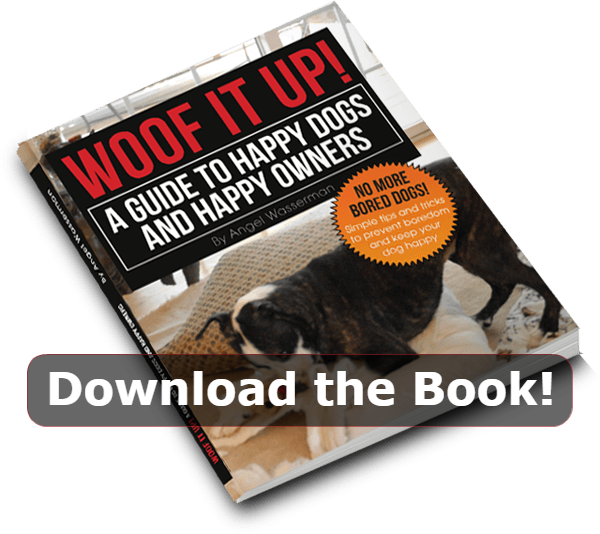
There are hundreds of things you can do with a dog recovering from surgery that require only use of the eyes, the snout or a single paw.  There are 80 such games in the Woof it Up, Play & Train Kit which have been tested and perfected with dogs wearing e-collars and those with limited mobility.  Pick a game and get started! Your dog will appreciate having something to do and you’ll appreciate all the things he is learning.  Available at www.noboreddogs.com

4. If your dog is restricted to his crate, place novel things in the environment that he can look at.

Staring at the same walls through the crate will get boring quickly.  If possible, move the crate every few days to achieve the same purpose.

5. Utilize the dog’s most primal sense; his sense of smell.

It can be quite enriching for some dogs to be exposed to scents.  Place a drop of lemon extract on the floor in the same room as the crate (not in the crate please.)  Change the scent every two or three days by using a drop of lavender, or vanilla.  A dog’s sense of smell is significantly superior to ours so a single drop of scent placed at least ten feet away from the crate will do the trick. You might also consider using a dog appeasing pheromone known as DAP.  This chemically recreates the scent of mother’s milk and many dogs find this calming.  DAP can be purchased in most pet stores.

6. Utilize touch exercises and canine massage.

Both enhance circulation and will relax your dog’s mind and body.  If your dog is depressed after surgery, purposeful touch can help considerably.

7. Rotate toys to keep them interesting.

Consider purchasing five new toys of different shapes and textures.  Introduce them to your dog one at a time.  Remove the first new toy on day two when you introduce the next one and keep rotating them to keep interest high.  There is nothing like a novel toy to lift a dog’s spirits.

Unfortunately we cannot tell our pets that recovery is a process that will not last forever but we can tell them every day through our actions that we understand what they are going through and we can help them get through the boredom. Here’s to a speedy recovery!

Comments (0)

The Scoop on Poop: Thinking About Leaving Your Dog’s Poop Behind?

Filed under: Uncategorized — admin @ 10:44 am

Coming into contact with dog waste is a frustrating problem for humans and a health hazard for dogs and humans alike. Dog owners have likely heard that it is important to pick up their pet’s waste but perhaps they do not fully understand why this practice is imperative.  This article addresses the risks to dogs and humans from coming into contact with pet feces.  Dog owners, you and your dog are at risk too!

Internal parasites such as hookworm, roundworm and tapeworm reside in pet feces and they can infect both animals and humans.  When a waste pile is stepped on, the parasites can be transferred to the shoes or feet of an unsuspecting human and through the paw pads of the dog’s feet.  The parasites are then transported with every step you take…including into your home. Left behind, these parasites can also burrow into the ground infecting the soil. This leaves dogs, children and anyone else who walks over or plays in the area exposed to possible infection.

Giaradia, and Coccidia are parasitic infections that are spread dog-to-dog through direct contact with infected pet waste.  These conditions are very serious and can be life threatening for your pet.  Stepping in, sniffing, or eating of infected stool or soil are all transmission opportunities.

A common misconception about pet waste is that it is environmentally friendly and will dissolve as fertilizer.  This is a fallacy.  Pet waste attracts disease-carrying pests such as rats and flies. It can infect the ground and ground water supply and because it is protein based (unlike cow manure), can kill grass and shrubs.  Picking up pet waste is a critical dog owner responsibility.  Leaving it behind exposes you, your dog and everyone else who comes into contact with it to unnecessary risk.  The only way to keep yourself, your dogs and your neighbors safe is by picking up after your dog.

Signs of parasitic infection vary and may include lethargy, vomiting, stomach pain, diarrhea, mucus or blood in the stool or the presence of worms.  If you suspect that you or your dog has contracted a parasitic infection, seek medical attention right away.

For more information on the transmission of diseases through pet waste please visit: http://www.cdc.gov/healthypets/animals/dogs.htm


Comments (0)

July 13, 2012

Puppy Proofing Your Home

Filed under: ALL THINGS PUPPY — admin @ 9:15 am

I’ve been so busy!

Congratulations on your newest family member!  Your puppy does not yet know right from wrong or how to live in your household.  What he does know is that anything within his reach is a potential chew toy.  He can’t help chewing, HE HAS TO DO IT.  Puppies learn about their world and the objects in it by using their mouths.  Help your puppy to do the right thing by carefully puppy proofing the rooms he will be in.

Virtually all dog owners have chewing and destruction tales to share.  Know that being a puppy owner means you will likely lose something to puppy chewing.  How many objects you lose however is really up to you.  Puppies do not know the difference between what is acceptable to chew and what is not.  It is the owner’s responsibility to remove chewing temptations and to proactively guard against losing treasured possessions.

Step One:  Select the primary room which puppy is allowed in when he’s out of his crate.

Step Two:  Walk through the room and ask yourself, “What is in this room that is not replaceable?” What objects are sentimental?” Remove all objects that make it to your list.  Do you have cherished oriental rugs?  Collector edition books?  Irreplaceable figurines?  Ornate couch or chair pillows?  Books on bookshelves or racks holding CD’s or magazines?  Potted plants?  Pack these objects up and put them away until puppy is much older.

Step Three:  Now that you have removed your valuables, it is time to see the room from puppy’s perspective and there is only way to do this…on hands and knees.   Start in one corner of the room and work your way all the way around the room.  What’s dangling to entice puppy?  Perhaps there is extra fabric or tags stapled under a chair, phone cords or lighting cords dangling from tables or decorator cords or fringe on furniture or drapes.  If an object is dangling, it’s a beacon to puppy and most certainly will be chewed.  If your drapes or blinds hang within puppy’s reach, pin or roll them up so that puppy cannot get to them.  Magazine racks, books, CD’s and DVD’s, if stored within puppy’s reach, should be removed.

Wires, particularly in groups such as for your stereo or TV system, can be placed in plastic tubing made specifically for this purpose.  Tubing is inexpensive, easy to use and can be found at most home centers.  If you cannot protect the wires with tubing, consider elevating them to a place which puppy cannot reach or blocking puppy’s access to them.

Step Four:  When you have finished investigating from the ground, return to your original starting point in the room.  One by one, working your way around the room, sit on every piece of furniture you come to.  What’s in your line of sight from this position?  What objects are within grabbing or chewing reach?  Perhaps a cordless phone, the remote control?  Candles, candy dish or drink coasters?  A blanket draped over the back of the couch with wonderfully tempting fringe?  Yes, you guessed it, move all of those objects to higher ground if you cannot remove them from the room.  Please don’t second-guess which objects your puppy will chew.  He will chew anything he can reach including glass, metal and other objects that you would never imagine until you see it for yourself.  Don’t take chances!  If “it” is within reach, move “it” out of range.

If the thought of a nearly empty room depresses you, remember that puppyhood is very short.  As your puppy grows, learns and becomes trustworthy, you can decorate again.

Step Five:  Close doors to other rooms in the house and/or block them off with baby gates.  Puppies should never have free run of your home; that’s like giving your car keys to your 9 year old!  They simply are not ready for this responsibility and will not make good decisions.


Tip:  To prevent puppy from hiding, denning, or getting stuck under your couch, push empty boxes or under-bed plastic containers under the couch to prevent puppy and his toys from getting in.

Comments (0)

July 5, 2012

Is the Dog Park Right for Your Dog?

Filed under: Uncategorized — admin @ 6:30 pm

Dog Parks- Considerations for Pack Environments

Hear that happy howling?  That is the sound of delighted dogs throughout the Triangle.  The cause of this canine celebration?  They are going to the dog park!

Have you been longing to take your dog to a dog park?  Perhaps you just adopted a dog and are debating whether this experience would be good for him.  Below are some tips to help you decide if the dog park is right for your pet as well as a few tips to make your visit safe and enjoyable.

Will this be good for my dog?   If your dog has experience playing off leash with another dog, that is a wonderful canine experience.  But playing with one or even two, verses playing with the masses are not equivalent.  Before going to a dog park, it is beneficial to test the dog’s response to a pack environment in a controlled, monitored environment such as a dog daycare facility.  These facilities are staffed with professionals who are experienced in dog play and canine body language.  They can tell you if your dog is happy and soliciting new friends, or if the pack makes him uneasy, resulting in Fido not wanting to play.  Some dogs may become frightened or agitated within a large group of their furry peers, resulting in a not so pleasant experience.

Not all dogs are candidates for a dog park.   We have a dog in our pack that loves to socialize and the more dogs the better.  We have another who becomes overwhelmed when confronted by a pack.  There is nothing wrong with either dog.  Knowing your dog’s play preference and pack tolerance can help you make good decisions for your pet.

Good for socialization?  A dog park can be a wonderful place for a fully socialized dog to play with others.  It is not the place to begin socialization or to test if a recently acquired dog has been adequately socialized.   There is a world of difference between the two.  Socialized dogs have already proven themselves comfortable with the world around them and show no fear or aggression in the presence of strangers, crowds or large groups of off-leash dogs.  Equally important, these dogs have already learned through experience how to play with other dogs and respond appropriately to other dog’s signals and body language.  If your dog has not been through a formal socialization program or if you are unsure how your dog feels about being in a pack of dogs, please do not bring them to the park just yet.  Scheduling private play dates or participating in a doggie day care group will provide the answers you seek in an environment that is safe and non-threatening for your dog.  Putting an unsocialized dog into a dog park can be damaging.   Most dogs will not tolerate rude play behavior created by inexperience.  For the novice dog, this lack of understanding can result in escalating levels of corrections from the pack.  Unsocialized dogs are likely to fail in a pack environment and become overwhelmed resulting in fearful or aggressive behavior.

Toy and Treats:  Presenting toys or treats to your dog at the park will create a competitive environment.  To keep peace among the pack, it is best to leave those items at home.

Monitor your dog:  Watch your dog at all times so that you know what he is doing and with whom he is playing.  A dog’s behavior can change in an instant and it only takes the entrance of one dog with a different energy to turn an otherwise peaceful pack into a frenzied one.

Leashing:  In a pack environment where dogs are running free, having yours on leash puts him at a disadvantage and may make him a target.  A dog’s leash should be removed as soon as the gate closes behind you and shouldn’t be reapplied until you are back at the gate, ready to leave. If you are thinking to yourself, there is no way, I have to keep the leash on for control, your dog probably is not ready yet for the park.  Dogs have two ways to deal with stress…fight or flight.  Restraining a dog with the leash removes flight as an option. Even if the dog loves the park and knows everyone there, he has to be able to move away at his discretion.

Four on the floor:  It may be tempting to pick your dog up especially if a larger dog is running toward him.  Despite the best intentions to bring comfort to the dog this act will have the opposite effect if your dog is in a pack environment.   A dog in arms is restrained …even if he is in your arms…arms he loves.   Additionally, elevation is directly related to status in the dog world.  A dog in arms is naturally held higher than the rest of the pack.  The resulting action is that other dogs are likely to run over and start jumping at the restrained dog in an attempt to determine what warrants this coveted position above the rest of the pack.  Your dog is much safer on the ground.

Avoiding human conflict:  In a dog park, you will be in the company of dog enthusiasts, folks who may like to exchange stories and offer tips and advice.  This can be great fun and makes going to the dog park a social event for humans too!  Just keep in mind that dogs are often considered family members and owners may be sensitive to the comments and advice of others.  Criticizing another person’s dog or questioning an owner’s “parenting” skills is one of the fastest ways to create conflict. If you feel obligated to speak to another individual about their pet’s behavior, please be courteous and kind.  Try not to rush to judgment as things are not always as they appear to be and jumping to conclusions may create unnecessary conflict.

Speaking of which, many people are opposed to direct conflict.  Listen carefully to the things people say to you as these friendly strangers may be trying to tell you something about your dog’s behavior.  Very few people will ask another person to remove their dog from the park until there is a fight or a bite.  Often, people will make innocuous comments such as, “Wow, he’s really fired up today!”  “Does he always play like that?” or  “He sure doesn’t take no for an answer, does he?”  People may be trying to tell you that your dog’s behavior is making them or the other dogs uncomfortable.  If this is the case, you may want to take a closer look at your dog’s behavior.  A person swiftly leaving the park is another signal.  Pay close attention to this human behavior especially if the dog that is leaving was just playing with yours.  Many people find it easier to avoid a confrontation.

Body Talk

Dogs communicate with their bodies utilizing body language.  Canine body language is universal in the dog world and socialized dogs understand the language perfectly.  Unfortunately, these subtle cues are often lost on humans because we speak a completely different language!  Understanding canine body language allows you to decipher what your pet is saying to you…and the rest of the world.  And since he is communicating with other dogs at the park, it is in everyone’s best interest if you can eavesdrop on those canine conversations.   An excellent starting point is the article from the Association of Professional Dog Trainers (APDT) on Dog Park Body Language, available at http://www.apdt.com/petowners/park/bodylanguage.aspx.

Need more incentive to learn the basics of canine body language?  The next time someone says to you, “that dog’s tail is up, he’s dominant” or  “there’s an aggressive dog…his hackles are raised!” you will know exactly how to respond.  By the way, on a stand-alone basis, neither of these statements is true.  Considering only one characteristic of body language often leads to a faulty conclusion.

Dog parks can be excellent gathering places for socialized dogs and their humans.  Just remember that it is the dog owner’s responsibility to ensure that their dog is suited for this environment and is behaving appropriately while there.  Learning the basics about canine body language and safe play can help you make good decisions for your pet.  Not every dog is suited for an off-leash pack environment and your dog may be one of them.  But if he is suited, you and your dog are in for a great time!

Woof! Who’s up for a romp in the park?

Comments (0)

New Puppy Supplies List

Filed under: ALL THINGS PUPPY,Uncategorized — admin @ 6:26 pm

PUPPY SUPPLIES LIST

Items to have on hand before puppy comes home

Puppy food: Preferably the same food the breeder or shelter was feeding.  Dogs can get stomach upset from a rapid food change.  If you don’t like the particular brand of food your puppy is currently using, you can transition to a new food by following the directions on the dog food bag.  The transition should take roughly 7 days.

Food and water bowls:  Stainless Steel bowls are easy to disinfect and are virtually indestructible.  Your breeder may recommend a water bottle instead of a water bowl for some toy breeds such as the Shih Tzu.  Ask your breeder or veterinarian for their advice if you are unsure which type to purchase.

Litter Scents:  Obtain from the breeder or person you are getting the puppy from, a stuffed toy or piece of cloth that has been rubbed on the puppy’s mother, littermates, or the individual person too, so that it will have their smells on it. This can be very comforting to the puppy when it goes to its forever home.

Collar and Leash:  A flat cloth, buckle or snap cloth collar and a lightweight six-foot leash are recommended.

ID tag:  For safety sake, an ID tag with your contact information (including cell phone number) should be placed on the collar right away, even if you haven’t named your puppy yet.  Tags can be engraved at most pet stores for just a few dollars each.

Enzyme cleaner:  Regular household cleaners may remove pet stains but the odors remain for the dog even if the humans can no longer smell it.  Puppies will continually return to areas in which they’ve gone to the bathroom before and repeat their “accident” unless enzyme cleaners are used.  Our tried and true favorites are Urine Off and Zero Odor (available in most pet stores and on-line.)

Crate and gates:  You will need a place to put puppy when you can’t supervise him.  Crates are ideal and they have the added benefit of creating a safe place or den for puppy.  When selecting a crate, consider purchasing one that will be large enough to accommodate your dog when he is fully grown.  A dog should be able to stand up, turn around and stretch out completely without hitting the crate walls.  Most crate companies offer dividers so that the crate can be made larger or smaller.  If you prefer to contain puppy to one area, baby gates are ideal.  Note:  Unless your puppy is a toy breed, we recommend purchasing extra-tall baby gates.  Virtually all dogs will be able to jump over the standard size gate but even our wildest jumper hasn’t been able to get over the Kidco brand, extra tall baby gate.

Bedding:  Create a nest for puppy by placing bedding material in the crate.  We recommend lightweight, easily washable items such as towels or baby blankets for the first week.  If you are using crate pads or crate cushions, consider purchasing two of them so that puppy has a bed to sleep on while the other one is being washed.

X-large Stuffed Animal:  One of the fastest ways to get your puppy to sleep through the night is to provide him with a simulated littermate.  Purchase the largest, tallest, stuffed animal that will fit in the crate.  It should be large enough to mimic mom and allow the puppy to snuggle into it and/or lay on it.  Note: Stuffed animals should be filled with cotton batting not beans, which can become a choking hazard.  It is advisable to remove any loose or sewn on parts such as glass eyes or button noses.  Snuggle Puppies is a unique line of stuffed animals made specifically for this purpose.  They come in a variety of sizes and have battery-operated heartbeats, which may be soothing for some pups. 

Things to chew on:  Puppies need appropriate things to chew on and lots of them!  Consider purchasing a puppy Kong toy, toys made especially for puppies that are teething and several natural animal products such as dehydrated beef tenderloins or bully sticks.  Flavored Nylabones are a good choice for safety purposes but some pups won’t chew on them as they offer little flavor and chewing resistance.

Waste Disposal:  A multitude of pet waste bags styles and colors are available at pet stores.  These bags are very convenient for picking up after puppy.  A pooper-scooper may also be handy to clean up waste in your own yard.  Tip:  Get a 5 gallon paint bucket with lid from your local home supply store and place 2-3” of kitty litter on the bottom of the bucket.  Place your used waste bags in the bucket and keep them there until trash day.  This keeps your yard clean and tidy, reduces smells and keeps flies from invading your garbage can.

Brush:  A soft bristle brush should be used to get your puppy accustomed to handling and grooming.  You will want to introduce puppy to brushing immediately so that he accepts your touch and brushing as something that’s normal and natural in his world.

Puppy toothbrush and toothpaste starter kits:  One of the best things you can do for your dog’s health is to brush their teeth and the best time to introduce them to this procedure is when they are puppies.  Kits are available in most pet stores.  Note: Never use human toothpaste on dogs, fluoride can be toxic.

Comments (0)

Toys we recommend for puppies and older dogs too!

Filed under: ALL THINGS PUPPY — admin @ 6:23 pm


Toys provide mental stimulation for dogs.  For young dogs that spend considerable time confined in a crate, toys can mean the difference between sheer boredom and a happy, balanced existence.

There are hundreds of toys on the market and a pet parent’s biggest challenge may be determining which toys are safe for their pet.  While no toy is 100% safe, the guidelines that follow will help you select suitable  and safe toys for your pet

One product does not fit all

Every dog has his or her own preference for toys.  Some prefer plush toys, others prefer balls and still others prefer hard plastic or rubber toys.  Instead of purchasing a dozen toys for your new pup, you may want to purchase three toys ensuring that each is a different texture and type.  Your dog will quickly show you his preference.   Different textures also provide a level of excitement, as each toy offers a unique chewing experience.  For example, three balls will not have the same engaging ability as three different toys such as a tennis ball, rope toy and plush toy.

How do I know what toy is safe for my pet?

There is no such thing as a 100% safe dog toy because every dog plays differently and has a different chewing style.  A toy’s safety is a function of knowing your dog and how he interacts with specific toys.  A good way to identify your dog’s play style is to spend a few hours watching him play with his toys.  If he has a plush toy that squeaks, is he content to toss the toy or is he compelled to “kill” the toy by destuffing it and chewing on the squeaker?  Does he bat around his tennis ball or does he immediately strip off the fuzz or chew the ball into pieces?  Does he chew contently on a rubber toy or break it into several pieces?  Young puppies typically do not have the jaw power to demolish toys but that changes quickly as they age.  A plush toy that may prove “safe” for your 8 week old may be immediately destuffed by your 12 week old.  As such, you should retest your dog with specific toys every few weeks.  If you notice changes in his chewing or play styles,  select new toys to test.

Size and Shape

Toys should be size appropriate for your pet.  It is tempting to purchase a 3-inch toy for a small dog but bigger is often better.  Small toys may be accidentally swallowed presenting a choking hazard and may also create a life-threatening intestinal obstruction.

The shape of the toy should also be considered.  Typically, the more appendages a toy has, the greater the risk of the toy being pulled apart.  For example, an 8-legged spider will probably have a shorter life span then a one-piece egg shaped toy.  For safety purposes, once a toy becomes warn or ripped, it should be discarded.

Keep Toys Interesting

Puppies have short attention spans and get bored with their toys quickly.  The best way to keep toys interesting for your pet is to rotate them.  You may want to leave out your pet’s favorite toy along with two or three others and exchange them for three or four different toys every two to three days.  The fastest way for a toy to lose appeal is to make it available for the dog day after day.

Beyond the Squeaker

If your dog loves plush toys but cannot resist destuffing to get to the squeaker, you may want to consider plush toys that are stuffed with crinkly paper or plush toys that have no squeaker.

Food-Dispensing Toys

There are a multitude of products on the market which challenge your pet and release food treats too.  While Kong may be the best-known brand, food-dispensing toys come in a variety of different shapes, sizes and technical difficulty to keep your pet challenged.  For added stimulation, provide two or three different food-dispensing toys.  These toys can be used in place of a food bowl to dispense meals and others can be used to dispense tasty treats.

Food-dispensing toys can be filled with healthy foods such as plain, non-fat yogurt, sweet potatoes, pumpkin pie filling or high quality canned dog food.  As your pet becomes proficient with the toy, increase the challenge by freezing the stuffed toy to create a canine popsicle.

Toys for teething pain

The brand Pet Stages offers several toys that can be frozen to provide cooling relief to sore gums including their “Cool Teething Stick”

Nylabone brand, Puppy Teething Keys

Dog Toys we particularly love and recommend:

Feeder Toys

  • Jolly pets brand, Monster Mouth .  Ditch the dog bowl and feed your pet’s kibble from these exciting kibble dispensing toys.  3” Monster Mouth holds ¾ cup of large kibble or 1 cup of small kibble.
  • Our Pet’s brand, Atomic Ball.  The Atomic Ball comes in a 3-inch size which holds approximately 1 cup of kibble and a 4-inch size which holds up to 1 ¾ cups of kibble.

These products Turns mealtime into a stimulating event and slows down even the fastest eater.

Tip!  To ensure that your dog views these as vessels for food and not chew toys, pick them up immediately after they are empty.  After 6-8 meals, most pets will leave them alone unless they find food in them.

 
Toss and chew dog toys
  • Tuffy’s brand Ultimate dog toys are made with 4 tough layers. Excellent for chewing and tossing and holds up better to power chewers then any other toy we tested. Over 20 different shapes and sizes available
  • Skinneeez brand, stuffing-free plush toys. 
  • Simply Fido brand, 100% organic material, stuffing free
  • Jolly Pet’s brand, football.  Even our endless chewing pit bull can’t kill this thing!  Teethmarks?  No problem, the football does not deflate!  Finally, something our boy Zeus can’t destroy!

For their chewing enjoyment

  • Antlers; a healthy and natural chewing product.  Available in Moose, Deer and Elk.  Some dogs show a preference for a specific animal type.  If your pet does not settle down to chew one type, try them with another animal type.  Note:  Animals are not killed for their antlers; they fall off the animals annually.

Always test your pet with new toys to ensure that the toy is safe for him.  Retest as needed as your pet matures.

Happy Playing!


Comments (0)

How to get your puppy to sleep through the night

Filed under: ALL THINGS PUPPY — admin @ 6:07 pm

Bringing home a puppy is similar to bringing home a newborn; an uninterrupted night of sleep will not be yours for a while.  The following tips will help you survive the first few weeks with your puppy.

Tip #1

Take up the food and water bowl two to three hours before his scheduled bedtime.

Tip #2

After dinner, many puppies take a lengthy nap.  Instead of letting puppy sleep for hours, let him sleep for 30 minutes then wake him up and keep him up.  If puppy is coming off a two to three hour post dinner nap, he is not going to sleep through the night.

Tip #3

Your puppy has just left his mother and siblings for the first time so you can understand why he may be scared when he wakes up and finds himself all alone.  Placing a GIANT stuffed animal in the crate can create comfort.  Ideally the size is large enough for puppy to snuggle under or on top of, mimicking the “puppy pile” he naturally equates with safety and warmth.

Tip #4

If puppy came from a breeder, he or she may have provided you with a toy or piece of cloth that was rubbed on the mother and littermates.  Placing this item in the crate will help your puppy feel more comfortable.  If your puppy did not come with such an item, place a T-shirt you have worn but not washed in the crate so that puppy has your scent.

Tip #5

Dogs are pack animals and in the wild, the pack sleeps together.  A puppy coming home for the first time will typically sleep longer if his crate is in a location where he can see or smell you when he wakes up.

Comments (0)
  • Recent Posts
    • Why Doesn’t My Dog Listen To Me?
    • Breaking Bad Habits In Dogs
    • 7 Ways to Keep a Dog Recovering from Surgery Busy
    • The Scoop on Poop: Thinking About Leaving Your Dog’s Poop Behind?
    • Puppy Proofing Your Home
  • Recent Comments
    • Archives
      • January 2013
      • July 2012
    • Categories
    • Categories
      • ALL THINGS PUPPY
      • Uncategorized
    • Meta
      • Log in
      • Entries RSS
      • Comments RSS
      • WordPress.org

    Home | About Us | Services | Testimonials | Understanding Dogs | Training Misconceptions | Disaster Planning | Articles | FAQ's | Educational Blog | Pet Resources | Contact Us